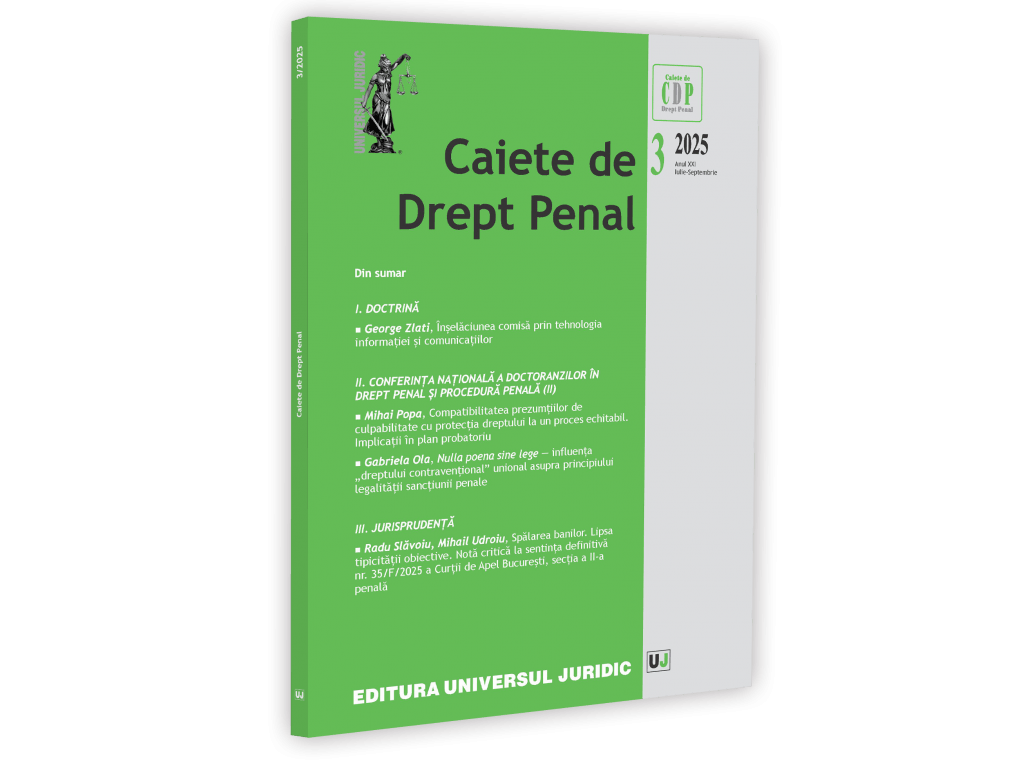
Nulla poena sine lege – the influence of EU “contraventional law” on the principle of legality of criminal sanctions
DOI:
https://doi.org/10.24193/CDP.2025.3.5Keywords:
nulla poena sine lege, CJEU case-law on administrative sanctions, ne bis in idem, contraventional-criminal dualityAbstract
This article aims to examine how the principle of legality of criminal sanctions is being influenced by European Union “contraventional law”, the latter referring to both regulations that establish administrative sanctions under the jurisdiction of EU institutions and national laws that implement Union law by means of contraventional law.A significant part of the Court of Justice of the European Union case law on nulla poena sine lege concerns cases involving administrative sanctions imposed by EU institutions. Therefore, in the first section, we shall try to outline the distinction between contraventional and criminal law to determine whether nulla poena sine lege carries the same legal authority in contraventional matters as it does in criminal law. We shall then analyze the Court’s case-law mentioned before to assess the extent to which its conclusions align with the guarantees typically associated with the principle of legality of criminal sanctions.
The second part of this study explores the implications that the overlap between administrative and criminal law may have on the principle of nulla poena sine lege. We will first investigate why and how the recognition of the ne bis in idem principle may influence the clarity of criminal sanctions. Finally, through an analysis of the relevant case law from both the Court of Justice of the European Union and the European Court of Human Rights, we will consider the potential impact that limitations on the ne bis in idem principle may have on the principle of legality.