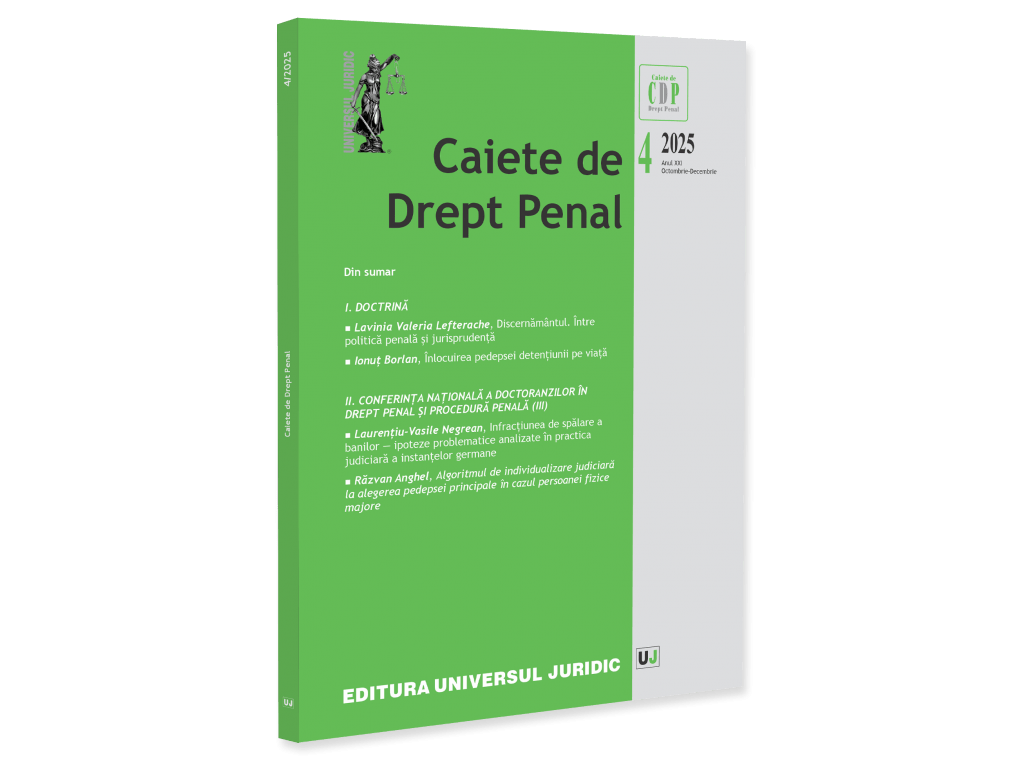
Replacement of life imprisonment
DOI:
https://doi.org/10.24193/CDP.2025.4.2Keywords:
life imprisonment, humanitarian grounds, rehabilitation and reintegration, review mechanism, European legal standards, criminal policy, Romanian Criminal Code, criminal execution law, elderly convicts, mitior lexAbstract
The replacement of life imprisonment with a prison sentence on humanitarian grounds transcends purely domestic legal frameworks, finding its doctrinal and normative roots in European and international human rights law, especially following the abolition of the death penalty. Building upon the humanistic traditions emerging in the 18th and 19th centuries, contemporary legal systems must reconcile the severity of life sentences with the fundamental principles of rehabilitation and social reintegration. Under European case-law standards, life imprisonment is deemed compatible with human dignity only insofar as it remains de iure and de facto reducible. This requires a clear mechanism for review from the outset of applying the punishment, ensuring that the prospect of release is not a mere illusion, but a tangible possibility that preserves the proportionality and fairness of the sanction.The urgency of such mechanisms is amplified in the case of elderly convicts, for whom the remainder of their life becomes indistinguishable from the indeterminate duration of their sentence. Within the Romanian legal framework, the replacement of life imprisonment, alongside conditional release, serves as a vital safeguard for maintaining the sentence within humanistic boundaries. However, this institution has undergone significant structural transformations following the enactment of the current Criminal Code.
Despite more than a decade of applicability, the current legal framework has yet to achieve exclusive prevalence, as it continues to compete with more favorable provisions of previous legislation. This study provides a comprehensive analysis of the institution of replacing life imprisonment, exploring its multifaceted implications in relation to both substantive criminal law and the law of criminal execution, while addressing the persistent challenges in its judicial application.